A full year of Smart DNS for about forty dollars or less - ranked on real annual prices.
Short answer:TrickByte is our top-rated budget Smart DNS as of 2026-09-23 (4.5/10), from $2.08/mo, 14-day free trial without a card.
providers on this page: 3 · active today (excl. watch list): 3 · standalone DNS specialists: 3 · VPN-bundled Smart DNS: 0
quick picks
The cheapest documented year with a real trial behind it→TrickByte - 39.96 USD/yr and a 14-day no-card trial - test first, then own the cheapest seat in the market
Just under the corridor with a 30-day refund net→KeepSolid SmartDNS - 29.99 USD/yr with a 30-day money-back policy - the refund-backed budget option
Cheap plans and a long 14-day no-card trial, but a stale site with dead services still listed and refunds purely at the operator's discretion. Treat as semi-dormant and test heavily in the trial.
14-day free trial (no card)VPN includedmultiple locations
Cheap ($2.99/mo flat) with DoH/DoT and 3 simultaneous locations, run by a named individual with no published company - and strictly no refunds. The 3-day trial is the only safety net.
3-day free trial (no card)multiple locationsDoH/DoT
The true-price picture, from documented list prices
Documented annual prices across this page's population - the corridor from cheapest to median, with the operators that doubled prices between 2024 and 2026 marked.
Every number on this page comes from the operators' own pricing pages - live captures where the site loads, archived captures where it blocks datacenter requests (the sources list the capture dates). The honest shape of the market:
The corridor: cheapest documented year $29.99, median ~~$35.88, effective months from $2.08/mo at the floor. Even the premium tier of the standalone market costs less per month than a single coffee - the price spread matters less than the terms around it.
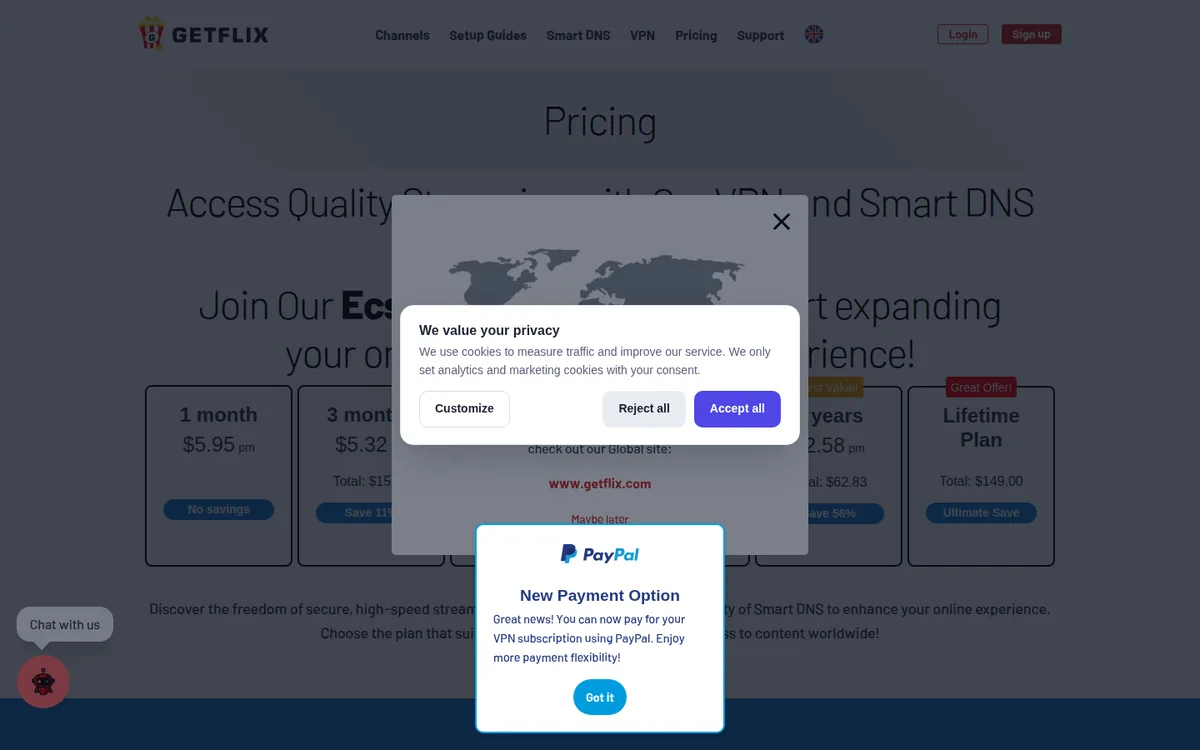
The doubling wave: between the 2024 and 2026 pricing snapshots, two long-standing operators roughly doubled their list prices - visible by comparing the [2024 archived Getflix pricing][2] against the [2026 capture][1], and the same pattern in [CactusVPN's before/after][3][4]. Anyone quoting "budget Smart DNS prices" without a capture date is quoting a market that no longer exists.
The free-riding tier: VPN bundles include Smart DNS at $0 marginal cost - but only while you want the whole bundle. The VPN-bundle hub does that arithmetic honestly, including the operators that discontinued their Smart DNS feature (1 tracked removals).
Why "cheap" and "cheap forever" are different questions
Live values from our database - details and caveats in each review. "-" = not documented by the operator.
The sticker is one line of a three-line story:
Intro price - what the checkout page shows. Least informative.
Renewal price - what year two costs. The 2024-26 doubling wave means the renewal line moved more than any other number in this market. Where an operator has a documented history of hikes (the captures above), treat the current price as a ceiling that can move at any renewal.
The exit price - what a wrong choice costs. Providers with a no-card trial plus a refund window cost $0 to be wrong about. Providers with neither (0 on this page) convert every cheap sticker into a full-price bet. The free-trial hub keeps the testable list.
That is why the price calculator exists as a tool rather than a table: it ranks your shortlist on true cost - the renewal price net of what you can recover - instead of the intro sticker.
The under-40-dollar list, honestly
The budget tier on this page (annual price at or below $40) is a real market, not a clearance bin: 3 providers document annual plans here, and the cheapest documented year is $29.99. What separates the good cheap options from the merely cheap:
Trial or refund behind the price. The best budget picks pair a low annual with a no-card trial or a 30-day refund - the safety stack costs the operator goodwill, not margin, and its absence on an otherwise-cheap plan is a signal to read the review closely.
Documented services, not vibes. A plan that documents the services you watch beats a $55 plan that "unblocks 400+" without per-service evidence. The table's service columns are the live audit; the channel checker is the pre-purchase test.
Price ladder sanity. Operators that offer 1/2-year and lifetime tiers let you upgrade the commitment as trust accumulates - the lifetime hub runs that end of the ladder against operator survival rates.
The bundle arithmetic (the cheapest Smart DNS is not a purchase at all)
Getflix pricing page, archived capture 2026-09-21 - the veteran's price ladder from monthly to 2-year to lifetime
If you already pay for a large VPN, its Smart DNS feature may be included - making the DNS's effective price $0/month on top of money you already spend. The honest comparison then shifts from "which DNS to buy" to "which part of my existing stack is underused". The trade-offs, in one breath: bundled Smart DNS historically supports fewer services (several large VPNs document Originals-only Netflix support), and the 2026 wave of feature removals (1 tracked on this site) means the bundled feature can vanish from under you - the VPN-bundle hub documents who kept theirs.
The taxes, currencies and fine print
Three details that move the real number by 10-20%:
Checkout taxes - Australian operators add GST, EU operators add VAT, and the USD list price on a marketing page is not the checkout total. The review pages note billing regions per operator.
Currency at renewal - local-currency billing converts at renewal-time rates; the USD figure drifts with exchange rates. Trivial in calm years, visible in volatile ones.
Promotional stacking - coupons and "limited" offers reset the intro/renewal gap problem rather than solving it. Rank on renewal, always - the calculator does.
The budget decision in one paragraph
For a proven, tested use case (your catalogs work, your devices are set up), the cheapest documented annual that passes the trial test is the right buy - the corridor's floor is real value. For an unproven case, buy monthly until the test ritual has passed once. Never prepay blind on the no-refund tier, and treat any price you see as the current price in a market that just doubled twice - the capture-dated sources on this page are how you keep receipts. When the budget question is really "do I even need a separate subscription", the DNS vs VPN tool answers it before you spend anything.
The monthly-vs-annual decision tree
The cheapest annual plan is only "cheap" once you know it works for you - which makes the correct first purchase monthly more often than not:
New setup, new country, new device class - buy monthly at ~1.5-2x the annual's effective rate for one or two cycles. The premium is the price of not prepaying an unproven hypothesis, and it is cheap insurance against the 0 no-exit operators.
Test ritual passed once - the catalogs work, the devices hold the setup, one route repair survived. Annual is correct from here; the free-trial hub defines the ritual.
Stable for a year - now the commitment ladder opens: 2-year tiers (where offered) discount further, and the lifetime hub runs the end of that ladder against operator survival.
The counterintuitive part for budget shoppers: paying monthly first is the budget strategy, because it converts every later prepayment into an informed one. The people who overpay in this market are almost never the ones who bought monthly first - they are the ones who bought the cheapest annual blind.
Where the money actually goes
A budget-tier subscription funds a real cost structure, and knowing it explains the price differences on this page better than marketing does:
Route maintenance - the unblocked services' endpoints move constantly (platforms rebrand, edge servers change); every provider runs detection and repair pipelines against them[9]. This is the fixed cost that keeps your setup working, and the main thing a too-cheap plan underfunds.
Infrastructure - DNS anycast networks, region endpoints, and the dashboard. The veterans have amortized theirs for a decade; young operators pass setup costs into year-one pricing.
Support - human support costs. The AI-support trend among newer operators is a budget signal: cheaper to run, and the reviews document response quality where it changed.
Payment processing and refunds - card fees, chargeback reserves, and the goodwill budget behind money-back guarantees. Operators that offer no refund reduce this cost - and shift the risk to you (the free-trial hub quantifies that shift).
Read this way, the market's spread from $29.99 to ~~$35.88 buys mostly age and support depth - both of which matter more the longer you plan to stay, and neither of which the sticker shows.
The regional tax wrinkle
Budget comparisons across operators regularly miss 10-20% to taxes and currency: Australian operators add GST at checkout, EU operators add VAT, and the USD sticker on a marketing page is not the invoice total. Two habits keep your comparison honest: rank on the checkout total in your region (the calculator flags the operators that add tax), and re-check the exchange-rate drift at renewal for local-currency billing. Neither is a dealbreaker - but both have flipped close price comparisons in practice, and neither appears in any operator's headline price.
On this page's population the cheapest documented year is {{stat: annual_min}} and the median sits at ~{{stat: annual_median}}; effective monthly prices range from {{stat: eff_monthly_min}} to {{stat: eff_monthly_median}}. VPN bundles add $0 on top of an existing VPN; lifetime deals run $149-200 once.
Are cheap Smart DNS services worse?
Not inherently - price correlates with company size, not unblocking quality. What price does predict is the maintenance budget behind route repairs and the safety net (trial, refund) around your purchase. Check documented services and refund terms before assuming the brand premium buys anything you need.
What is a renewal jump?
The gap between your first invoice (with promotional pricing) and the second. The market's documented pattern is steep: two veterans roughly doubled list prices between 2024 and 2026 - the archived pricing captures in the sources show the before/after. Always rank on renewal price, not intro price.
Are annual plans risky?
Less with a refund window behind them - test in the first days, decide inside the window, and prefer operators with a no-card trial first. A cheap year with no trial and no refund ({{stat: no_refund_n}} providers on this page) is the riskiest product shape in the market.
Is a lifetime deal the budget play?
Mathematically it breaks even after 2-4 annual cycles - but only if the operator survives. The lifetime hub runs the survival math against the {{stat: dead_n}} dead providers this site tracks; the short version: lifetime is a bet on operator longevity, not a discount.
Why do prices differ so much between providers?
Small operators price low to win on price alone; large brands price the bundle. The DNS product is nearly identical at the protocol level - what you pay extra for is route maintenance, support depth, and the number of unblocked services.
Do these prices include VAT or sales tax?
Depends on the operator's billing region - Australian and EU operators add GST/VAT at checkout, US-priced operators often include it. The documented prices on this page are USD list prices; the calculator flags the operators that add tax at checkout.
Can I pay monthly instead?
Yes, everywhere - at roughly 1.5-2x the effective monthly rate of annual. Monthly is the correct choice while your service list is unproven (new device, new country); annual once your test ritual passed.
Do prices differ per region or currency?
Some operators bill in local currency (AUD, EUR) - the converted USD number moves with exchange rates at renewal. The reviews note the billing currency; assume small annual drift.
Where do these prices come from?
Operator pricing pages, live or archived captures (the sources list them with dates). Prices here are the documented list prices as of the access date - promotional flash sales are not ranked, and neither are gray-market resellers.