Real trials without credit card details - the honest way to test unblocking.
Short answer:TrickByte is our top-rated no-card Smart DNS trial as of 2026-11-09 (4.5/10), from $2.08/mo, 14-day free trial without a card.
providers on this page: 12 · active today (excl. watch list): 10 · standalone DNS specialists: 10 · VPN-bundled Smart DNS: 1
quick picks
The longest no-card test window→TrickByte - 14-day trial without card details - two full weekends to test every catalog on every device you own
No-card trial plus a refund window behind it→Smart DNS Proxy - 14-day trial, no card, and a 30-day money-back guarantee - the full safety stack on the widest service list
A short but completely card-free taster→Unlocator - 7-day trial without card, 72+ documented platforms, 30-day refund if you need longer
Cheap plans and a 14-day no-card trial, but the site is semi-dormant and still lists dead services, and refunds are purely discretionary - use the full two weeks on your exact services and do not pay beyond the trial until they work.
14-day free trial (no card)VPN includedmultiple locations
400+ claimed services, a bundled VPN and a 14-day no-card trial, while independent April 2026 tests found Netflix US broken although it is still listed - spend the trial window on your exact services before any annual or lifetime payment.
14-day free trial (no card)lifetime dealVPN included
from $2.85/mo14-day free trial, no card
400+ services★★★★☆3.8 (1)Smart DNS specialist 7 h ago
Technically the strongest DNS platform here (DoH/DoT/DoQ, 1009 documented services, 14-day no-card trial), but the operator calls unblocking best-effort and excludes it from refunds - buy it for per-service country rules, not if you only want one TV unblocked.
14-day free trial (no card)multiple locationsDoH/DoT
The category price floor at $2.99/mo, with a 7-day no-card trial and a 30-day money-back - the cheap entry if you watch on TV or mobile; check the Roku gap and the small operator before committing to a year.
Cheap flat pricing with DoH/DoT, custom overrides and three locations, run by a named individual with no published company and no refunds - the 3-day trial is your only safety net, so test the same evening you start it.
3-day free trial (no card)multiple locationsDoH/DoT
Verifiable Danish operator (Unlocator ApS, CVR 44498383) with 197 listed services, a 7-day no-card trial and a 30-day money-back - the strongest documented package in this comparison, even though the DNS-only price only shows at checkout. Start the trial, test Netflix and BBC iPlayer on your own TV, then take the annual plan.
A long-running Icelandic operator with honest trial terms (7 days without a card, 30-day money-back), but only 55 services and a logging claim an independent review disputes - start the trial with your own catalog before paying.
7-day free trial (no card)VPN includedmultiple locations
A long-running cheap bundle, but US unblocking has been broken for long stretches since 2024 and the trial is only 3 days - start the trial, test US services first and hold off the lifetime plan until they work for you.
3-day free trial (no card)lifetime dealVPN included
Only buy the hardware if the household is non-technical: the no-DNS-editing app and per-service country switching are genuinely easy, but refund terms differ per product and independent testing is thin - start with the 7-day trial.
Sells Smart DNS with a 3-day trial, 30-day money-back and Bitcoin, but discloses no legal entity and re-registered its domain in 2024 - test hard inside the three days and stay on a monthly plan while the operator is unverified.
Abandoned for years, no Netflix, a frozen service list and three different entity names - only the 14-day e-mail trial makes it testable; treat it as a cheap experiment, not a long-term plan.
340+ listed services and a no-logs audit, but Netflix US is missing from the operator's own grid, prices doubled since 2024 and the apps are stale - test your services in the 3-day trial and prefer the 2-year tier for value.
The two ways out of a bad buy: a no-card trial ends by itself before money moves; a refund window requires paying first and asking inside the window - with different paperwork.
This page exists because the two things marketed as "try it free" have completely different risk profiles:
A no-card trial moves no money. It ends on its own date. The only cost is your setup time. 12 of the 12 providers on this page offer one - the longest documented window on this page is 14 days.
A money-back guarantee moves your money on day one and hopes you are organized enough to ask back. It works - ~30 days median window across this page's population - but it depends on you noticing dissatisfaction before the deadline, and on the operator honoring its own policy (the review pages document the operator-specific conditions, some of which are restrictive).
The buying heuristic that follows: no-card trial first, refund window as the second net. A provider with both (12 trial takers, several with 30-day windows) gives you a zero-risk 30-44 day evaluation. A provider with only a guarantee is fine for people who read terms[6][7]; a provider with neither (0 on this page) is a prepayment bet - the review pages mark them in red.
The 72-hour test plan (that actually predicts ownership)
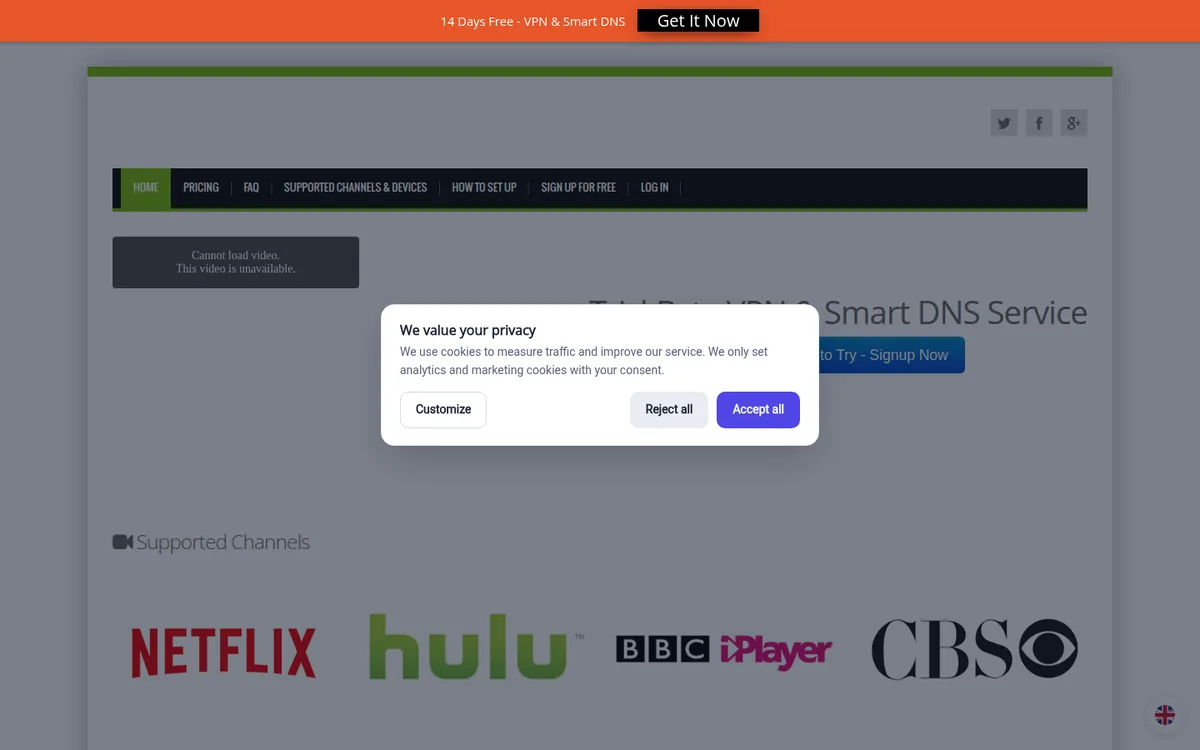
TrickByte homepage, live capture 2026-09-23 - the 14-day no-card trial documented on the operator's own site
Ten minutes of setup, three sessions of testing - this sequence catches ~90% of future problems:
Hour 0 - setup (10 min). Change DNS on the target device, register your IP in the provider dashboard. Do not test anything yet - a fresh setup's first lookup often hits a stale resolver cache. Restart the TV app once.
Hour 1 - the catalog test (30 min). Open your actual list: the ten titles you know are in your home library, the UK services you watch, the sports you follow. Playback quality at real evening hours, not a demo title at 10am. If your list fails here, no amount of "400+ services" matters - the channel checker makes the list printable.
Day 2 - the second device. The TV you will actually stream on, plus one fallback (browser or console). DNS behavior differs per platform - the Smart TV guide covers the per-OS quirks. Test the second household catalog here.
Day 3 - the resilience check. Reboot your router, watch whether the setup survives an IP change (or set up the provider's dynamic-DNS URL - 42% of providers document one). Read the provider's status page once. If a route broke and got repaired inside your trial, you have seen the maintenance loop that will define your ownership - that is valuable signal, not a bad trial.
Live values from our database - details and caveats in each review. "-" = not documented by the operator.
What the trial cannot tell you
Be honest about the limits of any test window:
Cat-and-mouse is stochastic. A route that works for 14 days can get flagged in week 6, and one that broke on day 2 may be repaired by week 2. Trials measure the current state, not the operator's repair discipline - which is why the review pages track repair history, and why this page's evidence column matters more than any trial snapshot.
Your catalog is not static either. The provider repairing routes and the platform tightening detection happen on independent clocks. Annual plans amortize this; monthly plans let you leave. The budget hub runs that trade-off with real numbers.
Bundles hide the DNS behind the VPN. Trial a bundled Smart DNS on its own merits - the VPN's quality is irrelevant to whether the DNS routes stay unblocked.
The refund-window fine print that bites
The operators' refund policies differ in ways that only matter at refund time - read them before paying, not after:
Exclusion clauses exist. At least one large operator's refund policy excludes renewals and has specific "eligible purchase" definitions - the [KeepSolid refund policy][8] is the readable example of the genre. The review pages quote each operator's actual refund terms verbatim.
Refunds are slower than charges. The [Unlocator refund guide][3] documents the process honestly: support ticket, processing days, original payment method. Budget the patience.
The trial-to-refund gap. Some operators subtract trial days from the refund window's effective coverage. If you trialed 14 days of a 30-day refund, you effectively have 16 protected paid days.
The no-refund list - who you are prepaying blind
0 providers on this page document neither a trial nor a refund. That does not make them scams - several are competent operators with pricing that reflects the risk they shift to you - but it changes what "cheap" means: a cheap year with no exit is more expensive per working day than a pricier year you can leave. The budget hub ranks the cheap-but-testable first, and the price calculator prices the risk explicitly. If you are going to prepay blind anywhere, at least prepay where the operator's 2011-era track record is documented in a review with dates.
The serial-trial strategy (how professionals buy Smart DNS)
Nothing stops you from testing several providers back to back before paying anyone - and for households with a complicated service list, that is exactly what the no-card trials are for. The discipline that makes serial trials honest rather than chaotic:
One provider active at a time. Overlapping DNS setups contaminate results - deactivate (or re-point) the previous provider's DNS before the next trial starts. A mixed state looks like "both providers are broken" and wastes the trial.
Keep the test list constant. The same ten titles, the same devices, the same peak hours for every trial - otherwise you are measuring your setup changes, not the providers. The provider-check page standardizes the list.
Record what you saw. A one-line note per service per provider ("Netflix home list: 8/10 titles", "ITVX: region error day 1, fixed after IP re-register") beats memory two weeks later - and it is exactly the evidence format the review pages use.
End each trial before starting the next. Not because it is required (no-card trials need no cancellation), but because the second trial's results should not inherit the first provider's stale resolver caches.
Two trials usually settle the market for you: the difference between a competent operator and a great one shows up in the resilience check (day 3) more reliably than in the first-session wow.
What to do when the trial fails
A failed trial is data, not a dead end - but only if you diagnose which of the four failure modes you hit:
Skipped setup step - IP not registered, DNS not applied on the target device, or 8.8.8.8 sitting in the secondary slot. Fix per the router guide and retest before judging the provider.
Wrong region configured - many providers default to a preset region set; the dashboard's service selector decides which catalog each domain maps to. A "broken Netflix" that is really a UK-route serving US expectations is a settings fix.
Provider-side route flag - everything broke at once, provider status page confirms. If the operator repairs it inside the trial, that is a positive signal about the maintenance loop - judge the repair, not the break.
Platform-side block - one service stubbornly fails while others work. That is the honest limit of the provider's current route; check the review page's evidence history to see whether this is new or chronic.
Only failure mode 4 without repair is a real "no". The other three are why trials exist - and why a provider whose support answers during your trial (the reviews rate support) deserves the benefit of the doubt over one that answers fast only in marketing.
Is a money-back guarantee the same as a free trial?
No, and the difference is money. A no-card trial never charges you and ends by itself; a guarantee charges first and pays back later - if you ask in the window, sometimes with conditions (some operators exclude renewals or refund only unused months). This page keeps the two strictly apart.
Why insist on "no credit card"?
Because a card-first trial converts into a subscription by inertia - the operator's reminder emails are conveniently easy to miss, and the cancellation flow is usually deeper than the signup flow. A no-card trial ends on its own date with zero action from you.
What exactly should I test during the trial?
The exact services and catalogs you watch, on the device you will actually use (ideally the Smart TV), at your usual peak time. And register your IP before the first test - the most common "trial failed" story is a skipped IP registration, not a broken provider.
Which providers have no trial and no refund?
{{stat: no_refund_n}} of the providers on this page document neither - paying them is prepaying without a test drive. The reviews mark those operators explicitly; treat the absence of both as a significant discount to the score[5].
How long do I need to test properly?
Two evenings is enough for the technical layer (setup, IP registration, one session per service); a full week catches the weekend-peak pattern and lets a route repair cycle play out. The 14-day no-card trials exist for exactly this - use two weekends.
Do trials limit anything technically?
Some do - reduced locations, fewer channels, or a bandwidth shape. The trial is the provider's own best behavior, so also read what the paid tier changes: the review pages note when trial conditions and paid conditions diverge.
Can I use a trial, cancel, and start another provider's trial?
Yes, serially - that is the honest way to A/B test providers before paying. Just do not register the same IP with overlapping active setups; deactivate one provider's DNS before testing the next, or your results mix.
What about "free" Smart DNS?
Free tiers exist (some operators run free DNS-only resolvers with reduced catalogs). They are fine for a permanent single-service need and useless as a test of the paid product, because paid routes and free routes are maintained differently.
Does the trial include the VPN part of a bundle?
Usually yes for bundle products, and the trial terms are the bundle's, not the DNS feature's. If your only interest is the Smart DNS, test exactly that feature - a VPN's trial performance says nothing about its Smart DNS routes.
What happens to my setup when the trial ends?
Nothing breaks dramatically - DNS stops resolving the unblocked services, everything else keeps working. Leaving the DNS configured is harmless but untidy; the provider dashboard keeps your IP registered for when you subscribe.