US streaming (Hulu, and the wider US set) from anywhere - documented per provider.
Short answer:TrickByte is our top-rated Smart DNS for Hulu as of 2026-11-09 (4.5/10), from $2.08/mo, 14-day free trial without a card.
providers on this page: 12 · active today (excl. watch list): 9 · standalone DNS specialists: 10 · VPN-bundled Smart DNS: 1
quick picks
Hulu documented plus the widest US service set→Smart DNS Proxy - Hulu, Disney+, Max and Prime cells on file - test the exact trio you watch inside the 14-day trial
Documented Hulu with a long refund window→Unlocator - 197 documented services including Hulu, 7-day trial and a 30-day money-back window
Budget-priced Hulu access with a no-card trial→TrickByte - 39.96 USD/yr, 14-day no-card trial - the cheapest way to verify Hulu works from your country before paying
Cheap plans and a 14-day no-card trial, but the site is semi-dormant and still lists dead services, and refunds are purely discretionary - use the full two weeks on your exact services and do not pay beyond the trial until they work.
14-day free trial (no card)VPN includedmultiple locations
400+ claimed services, a bundled VPN and a 14-day no-card trial, while independent April 2026 tests found Netflix US broken although it is still listed - spend the trial window on your exact services before any annual or lifetime payment.
14-day free trial (no card)lifetime dealVPN included
from $2.85/mo14-day free trial, no card
400+ services★★★★☆3.8 (1)Smart DNS specialist 7 h ago
Technically the strongest DNS platform here (DoH/DoT/DoQ, 1009 documented services, 14-day no-card trial), but the operator calls unblocking best-effort and excludes it from refunds - buy it for per-service country rules, not if you only want one TV unblocked.
14-day free trial (no card)multiple locationsDoH/DoT
The category price floor at $2.99/mo, with a 7-day no-card trial and a 30-day money-back - the cheap entry if you watch on TV or mobile; check the Roku gap and the small operator before committing to a year.
Verifiable Danish operator (Unlocator ApS, CVR 44498383) with 197 listed services, a 7-day no-card trial and a 30-day money-back - the strongest documented package in this comparison, even though the DNS-only price only shows at checkout. Start the trial, test Netflix and BBC iPlayer on your own TV, then take the annual plan.
A long-running Icelandic operator with honest trial terms (7 days without a card, 30-day money-back), but only 55 services and a logging claim an independent review disputes - start the trial with your own catalog before paying.
7-day free trial (no card)VPN includedmultiple locations
A long-running cheap bundle, but US unblocking has been broken for long stretches since 2024 and the trial is only 3 days - start the trial, test US services first and hold off the lifetime plan until they work for you.
3-day free trial (no card)lifetime dealVPN included
Only buy the hardware if the household is non-technical: the no-DNS-editing app and per-service country switching are genuinely easy, but refund terms differ per product and independent testing is thin - start with the 7-day trial.
Sells Smart DNS with a 3-day trial, 30-day money-back and Bitcoin, but discloses no legal entity and re-registered its domain in 2024 - test hard inside the three days and stay on a monthly plan while the operator is unverified.
Abandoned for years, no Netflix, a frozen service list and three different entity names - only the 14-day e-mail trial makes it testable; treat it as a cheap experiment, not a long-term plan.
340+ listed services and a no-logs audit, but Netflix US is missing from the operator's own grid, prices doubled since 2024 and the apps are stale - test your services in the 3-day trial and prefer the 2-year tier for value.
A verifiable Toronto company with flat $5/mo, but the VPN is discontinued, there is no trial and the domain expires soon - wait for the renewal or buy month to month and use the 7-day refund window.
Hulu's three gates: a US payment method (signup), the DNS route (what the providers on this page maintain), and the Live TV home network rule (account geography).
Hulu is the cleanest case of what Smart DNS can and cannot do, because the service draws its gates in bold:
US payment method. Hulu sells only in the US market, and signup wants a US-issued card. This gate comes before anything DNS-related - it is the expensive gate for most non-US users, and it is also the one that makes Smart DNS subscriptions look cheap by comparison.
The route. Every Hulu domain must resolve through a US exit. This is the provider's product: documented Hulu support means the operator keeps its US endpoints off platform blocklists and repairs them when flagged[8].
Home network (Live TV only). Hulu + Live TV requires setting a home network in the US and periodically confirming it; long absences degrade to on-demand. No DNS configuration changes this - it is enforced at account level.
If your plan is on-demand Hulu, you are dealing with gates 1-2 only. If you need Live TV (sports, locals), read gate 3 as a real constraint: your "home" is where Hulu says it is, and a DNS cannot renegotiate that.
Live values from our database - details and caveats in each review. "-" = not documented by the operator.
The Hulu column on this page's 12-provider population is mostly claimed rather than confirmed - 76 cells rest on operator documentation without a dated independent test, against 0 confirmed cells across the page's streaming services[8]. That does not mean Hulu is broken; it means Hulu's checks are lighter than Netflix's and the testing culture around it is thinner:
The US set tends to live and die together - providers that document Hulu almost always document Disney+ and Max alongside (see the adjacent columns)[4][7]. One infrastructure repair usually covers all three.
The failure reports that do surface are app-level and dated: an August 2026 community report documents Hulu Live TV blocked on one provider while the provider's Netflix kept working[2] - Live TV's home-network and edge checks are the fragile part, not the catalog.
Independent test rounds that do exist (April 2026 round[8]) mostly test the US set as a group, which is why the confirmed cells cluster on the providers with recent testing rather than the biggest channel claims.
The median operator here documents ~300++ services[6] - for Hulu purposes, the honest comparison is the four cells in the table above, not the headline number. The channel checker builds a Hulu-first test plan from those cells.
The buying sequence for a US-only service
Order matters more for Hulu than for any other service, because the account gates come first:
Secure the subscription - US payment method, US signup (with a US route already active from day one, so the account's region is consistent from birth). Providers cannot help here; our review pages list which operators document US-signup guidance.
Set up the DNS on the TV - Smart TV guide, then register your IP (the router guide covers the dynamic-DNS option for changing home IPs).
Test the actual use pattern - VOD playback on the TV app, and if you are a Live TV subscriber, the home-network setup flow. Live TV's home rule means "works abroad" for on-demand can coexist with "downgraded at home check" for live.
Buy inside a refund window - 11 of 12 providers on this page offer a no-card trial; pair it with a money-back window (~30 days median on this page) and the Hulu experiment costs nothing to unwind.
The Disney+ factor - check what you already have
The streaming-bundle reality changed the Hulu calculus: Disney's bundle consolidation moved Hulu content into Disney+ internationally for bundle subscribers, which means many users' actual need ("watch the shows I pay for abroad") is answered by their existing bundle plus a route - or not even that, depending on the plan. The honest sequence for {year} buyers: inventory what your current subscriptions already cover abroad, and only then decide whether Hulu-specific Smart DNS support is a purchase or a redundant line item. The price calculator totals the overlap.
What each Hulu plan changes for Smart DNS users
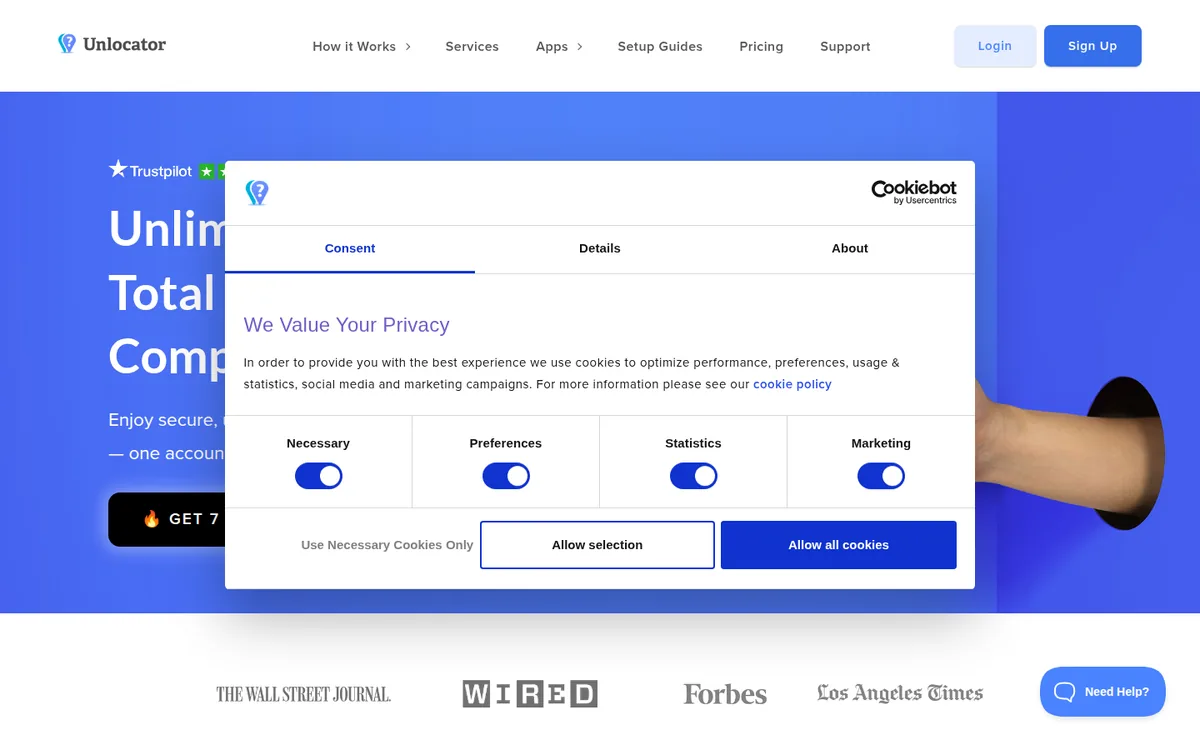
Unlocator's product page, live capture 2026-09-23 - the operator documents the US set (Hulu included) with per-service notes
Hulu is not one product; the Smart DNS value differs sharply per plan tier, and most bad purchases start with someone treating it as one:
Hulu on-demand - the clean case. One route gate, no home rule. This is what the providers on this page document and what a 15-minute trial test verifies. If you have a bundle that already streams Hulu content internationally through Disney+, you may not need this at all - check before buying.
Hulu + Live TV - the complicated tier. Adds the home-network requirement (a set US address, checked periodically), regional sports and locals that follow the home network, and the highest likelihood of the "works on-demand, fails live" split documented in community reports[2]. A Smart DNS helps the stream; it cannot fake the home.
The Disney bundle - same gates, three catalogs. The DNS routing handles all US domains equally; the practical benefit is that one provider covers the whole bundle without separate region selectors.
Plan arithmetic: on-demand Hulu plus a standalone Smart DNS is often cheaper per month than Live TV, and the price calculator totals the stack for your exact shortlist. If Live TV is the actual need, budget for the home-network constraint being a permanent one - the providers cannot out-engineer an account-level rule, and any that claim otherwise earn a red flag in the provider checks.
Device notes for the US set
The US apps are the friendliest class of streaming clients for DNS routes, with two exceptions:
TV apps (Samsung, LG, Fire TV, Apple TV) - the recommended path. DNS per network or router-level, no app-side location checks on the on-demand catalog. Setup follows the Smart TV guide.
Mobile apps - fine for on-demand playback, but they carry device-location permissions; if you grant Hulu location access on a phone, the app will prefer it over your route. Deny the permission or keep the phone app out of the critical path.
Game consoles - Hulu plays cleanly through console apps once the DNS is set per network profile; the fiddliness is per-profile DNS, nothing else.
Chromecast-class devices - the hardcoded-Google-DNS problem applies exactly as it does for Netflix: classic Cast sticks bypass your DNS and need a router-level redirect (the router guide documents the static-route trick).
Troubleshooting the classic Hulu failure modes
"Region error" after months of working - your home IP changed (router reboot, ISP change). Re-register the IP in the provider dashboard, or automate it with the provider's dynamic-DNS URL (33% of the providers here document one).
Ads on an ad-free plan - route slipped mid-session. Restart the app; if it persists, the provider's US edge for Hulu domains got flagged - check their status page before re-configuring anything.
Live TV downgrades to on-demand abroad - that is the home-network rule working as designed, not a DNS failure. No provider fixes it; the only honest workaround is a US household anchor (a family member's place setting the home network).
Whole US set broke at once - the provider's route, not you. Every US service failing together is the signature of a route flag; individual service failures point to app-side changes.
The US-set maintenance reality
Owning the US set through a Smart DNS is a low-drama ownership compared to Netflix: the catalog is static (US-only by design), so the provider-side work concentrates on keeping US routes off blocklists. The oldest operator on this page dates to 2011, and the graveyard - 8 dead providers tracked by this site - is what happens when route repair stops. Pick a provider with a documented repair record (the reviews carry the dates), keep the trial ritual, and treat any provider with neither trial nor refund (0 here) as a prepayment bet, per the free-trial hub.
Yes - the DNS route is solvable and the providers above document it. The hard gates are account-side: a US payment method at signup and (for Live TV) a US home network. Access from your country is the easy part of this stack.
Is Hulu harder to unblock than Netflix?
Comparable on the route level - both fight proxy traffic actively. The difference is structural: Hulu is US-only, so the goal is access to one catalog rather than catalog switching, and its Live TV product adds home-network checks that plain Hulu does not have.
Do I need a US payment method for Hulu?
Hulu's signup requires US payment - a US-issued card (some US prepaid cards work). No Smart DNS provider changes that; buy the subscription first, from inside a US route, then keep the DNS active for playback.
What is the home network rule for Hulu + Live TV?
Live TV requires you to set a home network - the physical US location tied to your subscription for local channels and regional sports. Traveling too long outside it can downgrade you to the on-demand library. This is account geography, invisible to any DNS setting.
Do these providers also unblock Disney+ and Max?
Most providers that document Hulu cover the rest of the US set - the Disney+ and Max columns in the table show the per-provider status with evidence levels. The US set tends to live and break together because the detection infrastructures are similar.
Why does Hulu show ads even though my plan has none?
Ad targeting runs region-side; a route mismatch can serve the wrong ad pod or trigger region errors. It is cosmetic compared to playback failures, but it is also the earliest warning that your route slipped - re-register your IP before debugging further.
Will Hulu detect and block Smart DNS over time?
It flags routes like Netflix does - the failure mode is playback errors, not account bans. A provider that keeps repairing US routes (the veterans here have decade-plus records) keeps Hulu working; operators that stopped investing lose it silently, which is exactly what the evidence column tracks.
Which device should I use for Hulu abroad?
The TV app on a DNS-configured Smart TV, Apple TV or Fire TV. Mobile apps add device-location checks; consoles work but the DNS edit per network profile is fiddly. The [Smart TV guide](/guides/smart-tv-smart-dns-setup/) ranks the device classes.
Does the Hulu-on-Disney+ integration change anything for Smart DNS?
It consolidates apps, not the gates - the same US payment, US route and home rules apply, and Hulu content now surfaces inside Disney+ internationally for bundle subscribers, which reduces the *need* for a DNS at all for some plans. Check what your bundle already includes before buying.
What should a Hulu trial test, exactly?
Signup-adjacent flows you will repeat monthly: login from the TV app, a VOD playback, and if you are a Live TV user the guide view - plus one replay of the whole flow the day before the trial ends. Hulu's catalog is US-static, so one verified session is a stronger signal than Netflix's moving target.